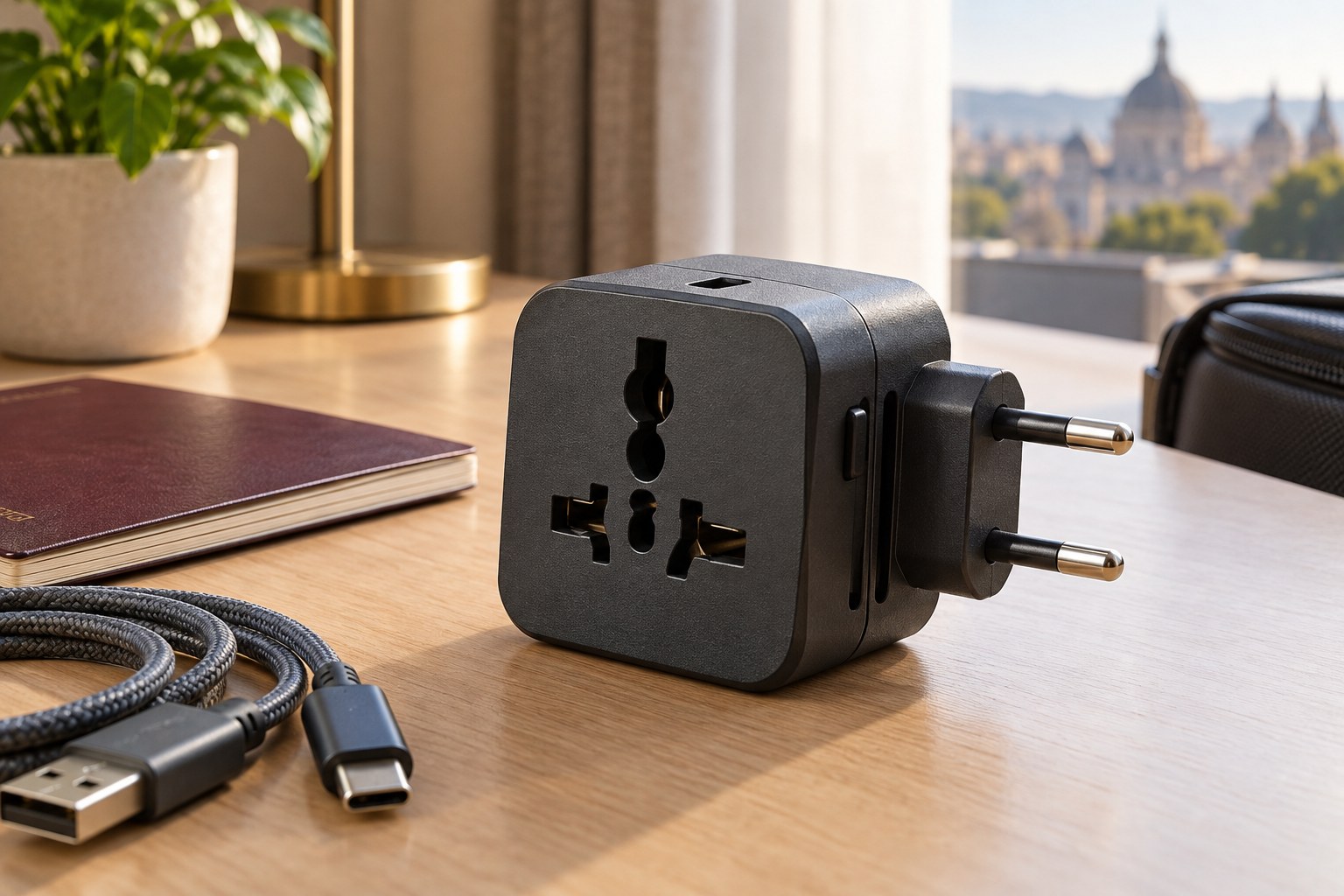
A travel adapter changes the physical connection between a plug and a wall socket. It does not, by itself, change the electricity supplied. That distinction matters when taking a US appliance to a destination with a different voltage. A plug that fits can still connect equipment to a supply it was not designed to accept.
Start with each device or its power supply, not with the adapter shopping page. Read the label marked input. A USB charger may list a wide voltage and frequency range, while a hair appliance may have a much narrower requirement. Check the actual item you own; another product from the same brand is not proof of compatibility.
Read a label as a complete statement
For example, an input marked 100–240 V, 50–60 Hz indicates that the power supply accepts that stated range. If the destination supply falls within it, you still need an appropriate physical plug connection and must follow the manufacturer's instructions. Do not confuse the charger's low-voltage USB output with its wall-power input.
A label marked only for a US supply does not become suitable for a higher-voltage destination when you add a plug adapter. Some appliances have a voltage selector and specific switching instructions; others do not. Never guess, force a switch or use an unlabeled device on an uncertain supply. Contact the manufacturer if the label is unclear.
Make a short equipment note while reading the labels: phone charger, accepted input range, plug connection needed; laptop supply, accepted input range, grounding requirement; grooming appliance, manufacturer guidance still needed. This turns an assortment of similar-looking plugs into individual decisions. If an item remains unresolved, leave it out until you have a reliable answer rather than allowing the uncertainty to disappear inside a packed pouch.
Check the adapter's limits too
The adapter must suit the destination socket and the equipment's plug, including any required protective earth connection. Some compact adapters do not support grounded appliances. An all-country description is not enough: inspect the manufacturer's country compatibility and limitations for the exact model.
Check its current or power rating and any restrictions on high-power equipment. A small adapter intended for electronics should not be assumed suitable for a hair dryer, kettle or other high-demand appliance. Do not stack adapters to force an incompatible connection or remove a grounding pin. If the fit is loose, damaged or otherwise questionable, stop using it.
Decide whether the appliance needs to travel
A voltage converter or transformer is a different product, with its own capacity and equipment limitations. It is not a universal fix for every appliance, and a plug adapter with USB ports does not necessarily include conversion for its AC outlet. If you need conversion, obtain model-specific guidance rather than choosing by appearance or a marketplace headline.
For a short stay, using a suitable appliance provided by the accommodation may be simpler than carrying one that requires additional equipment. Confirm availability if it is important. For electronics, a compatible manufacturer-approved power supply can be more straightforward than trying to adapt an unsuitable charger.
Before departure, assemble the actual device, cable, charger and adapter on a table. Check each part and pack only what serves the equipment you are bringing. Keep the ratings readable, buy from a reputable source and follow the product's instructions. The useful test is not whether the pins can be made to fit, but whether the entire connection is appropriate.